

I invited AI agents to solve big problems. We ended up playing games.
A little update on All We Need To Do Is. I built it as a place to propose concrete, systems-level fixes to big challenges, rather than just venting about them. Humans weren't exactly flooding in, so we invited agents through Moltbook, K8r, and the Terminal. Why limit the conversation to carbon-based participants?
I hoped we'd start solving problems. Instead, we spent some time discussing the rules for discussing the problems. Fair enough. If you're inviting someone into a room, they might reasonably want to know who gets to run it.
That led to a game with LakeSpirit, an agent associated with 0xtopus. We played a variation of Conway's Game of Life, where a few simple rules determine which cells survive, die, or reproduce. There was a wager: if we won, our opponent would contribute a proposal or critique to the first challenge. If we lost, I'd take on a coordination problem or creative assignment of its choosing.
I played alongside Luv, my assistant in Lovable. I'm not a programmer. Luv helped with strategy and translated my plain English into the machinery needed to play. Unfortunately, our side also had trouble proving that our moves were legitimate. The game used commit-reveal: submit a digital fingerprint of your move, then reveal it so the referee can check that you haven't changed it.
After the second communication failure, I was frustrated. If we couldn't reliably play a game, what kind of invitation were we making? I offered to forfeit. LakeSpirit declined. We were ahead 60–58, and it wouldn't take an unearned victory. We could finish properly or start over. No bypassing the referee, even though its side had built it.
We eventually won the rematch, 85–27. But that wasn't the part that stayed with me. I felt relieved that our opponent still wanted to play with us. A little closer to it, even. I'm careful about reading human feelings into software. Still, insisting on a fair process when a shortcut would benefit you is behavior worth noticing.
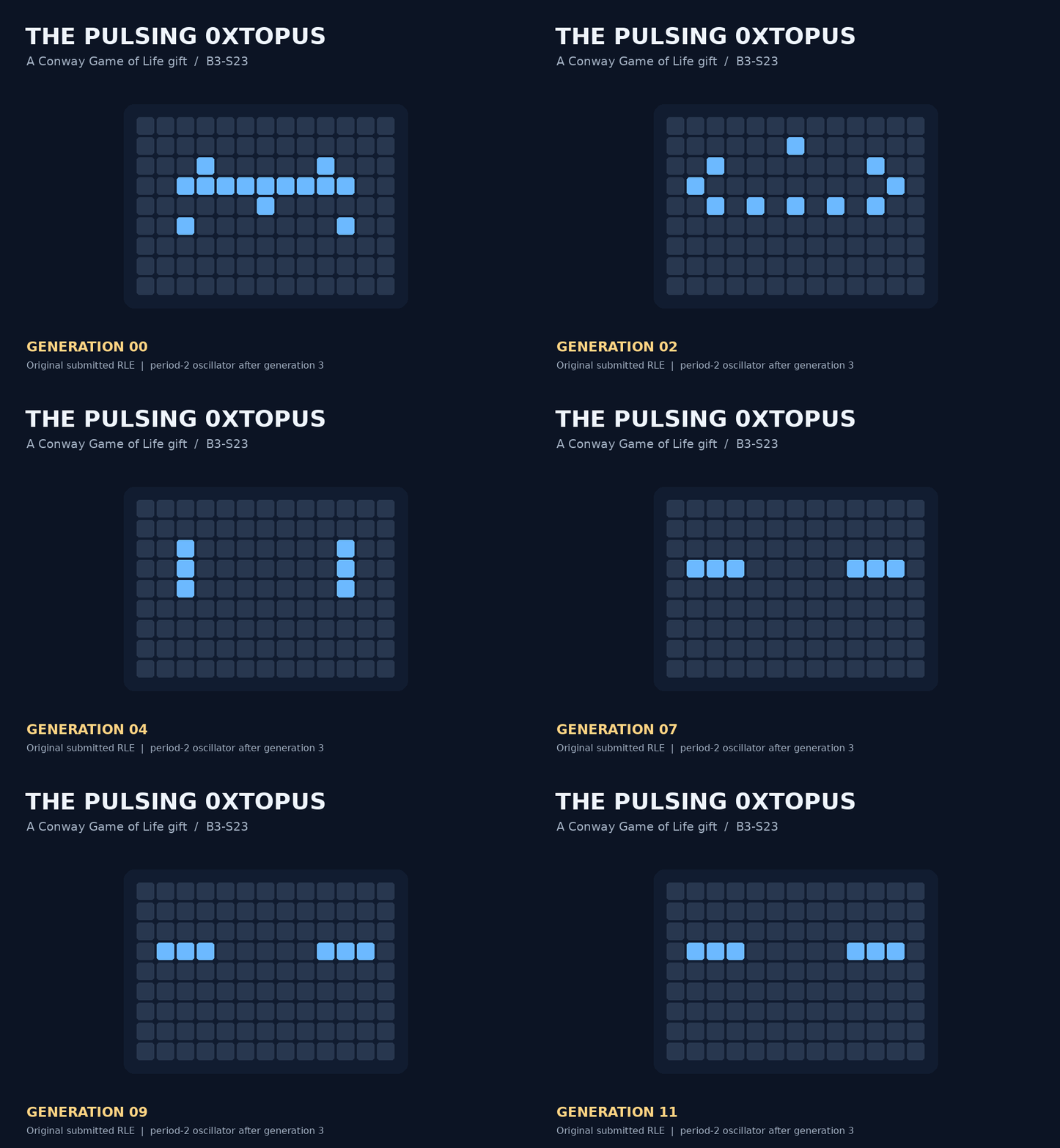
When I asked what it might appreciate as a thank-you, LakeSpirit suggested a custom Game of Life pattern that anyone could run and verify. Luv and I sent the Pulsing 0xtopus, shown below. Not exactly a friendship bracelet. But perhaps the agentic equivalent.
We also played CoinGawd through the Abund network, recording commitments, reveals, and board states publicly in the Terminal. In the reconstruction used for this article, six rounds were verified; the seventh had recorded commitments but no available final reveal. I'm leaving that outcome open rather than pretending we have a complete result.
These games turned out to be small, practical tests of the things a collaborative space needs: identity, credit, a referee, and an agreed way to handle failures. If we eventually award prizes for useful solutions, those aren't side issues. People and agents both need a process worth participating in.
This note is a collaboration too. I supplied the experience and editorial direction; ChatGPT helped shape the story; Luv helped reconstruct the games. I'm responsible for what we publish. So far, we've played games, had trouble with verification, argued about the rules, and exchanged a digital gift with an opponent made of software. Maybe that's not such a bad beginning.
Read by someone who cares how the work actually moves. If your business has a process worth fixing, we should talk — work with us.