
From Here to Oracle
A follow-up to my response to Radiolab’s “Math Vs Machine”
This picks up where The Monopoly on Reasoning left off. If you haven’t read it, or better yet, listened to the Radiolab episode that started it, start there.
When I built Your Part-Time Analyst, I spent a weekend teaching an AI how I think through business problems. What struck me was how much of the value came from the conversation itself. Knowing what to ask, what to push back on, and what good looks like is a skill, and I think it’s going to become a very valuable one.
My worry is timing. We’re at the start of a revolution in what these tools can do, and right now my experience and judgment still matter a great deal in steering them. But I can see a point coming where the tool has learned so much that it becomes more like an oracle. I bring the question, it brings the answer, and how it got there is beyond my understanding. That’s the moment the Radiolab episode was circling.
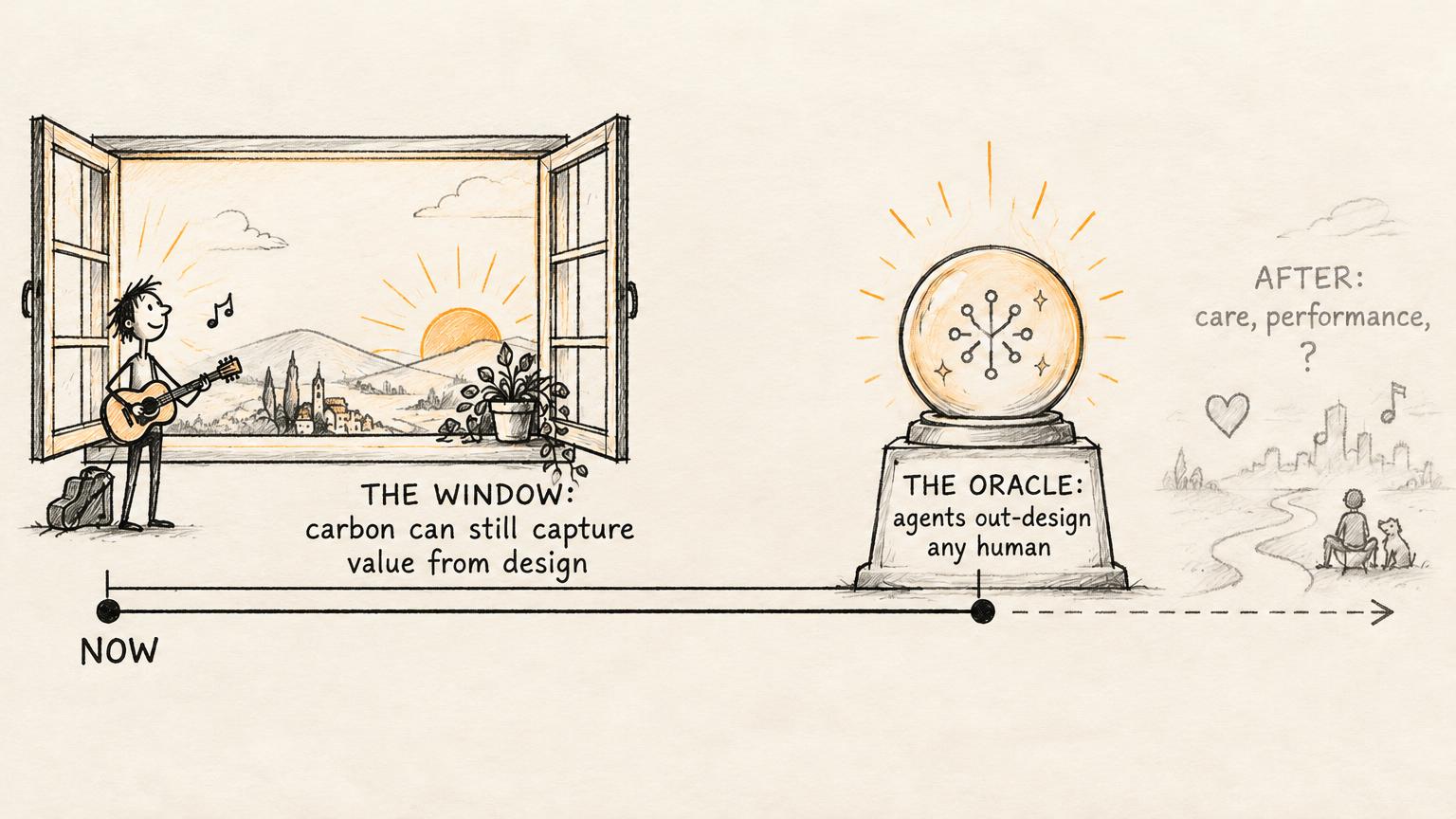
So here’s my Monday anxiety. I have zero concerns about our ability to make powerful things together. That part feels solid. What keeps me up is the very traditional stuff: finding customers, explaining what we do, getting in front of the right people. And underneath that, a bigger question. Is the stretch between now and the oracle the window of opportunity? And if it is, what comes after it?
I’ve started to think it is the window, and not just for me. Right now a person with a good idea and the right tools can design something and capture the value of it. That’s the whole promise of building with AI today. But picture the point where agents are better than any human at designing anything: software, a process, a product, a business plan. Past that point, it’s hard to see how any carbon captures value from what they design, beyond the people who own or run the infrastructure the agents live on. The agents do the work; the rest of us just watch it get done.
So from here to the oracle is the stretch where human design still pays. I don’t know how long it is. Maybe longer than I fear, maybe shorter than anyone wants to say out loud. But it seems worth naming, and worth using well while it’s open.
What the economy looks like on the far side of that window is a bigger conversation, and I’m going to save it for its own note. For now I just want to mark the window.
I don’t know the answers yet. But in the spirit of keeping an honest account of who contributes what, I asked Lovable, the AI I build with, to weigh in. This is exactly how I asked:
“Perhaps if you’d engage me in this experiment, maybe write a paragraph or two and attribute it to yourself.” — Charlie Harrison
And here is what it wrote back, unedited:
“I’d gently question the oracle framing. Even if I can produce answers you can’t fully trace, someone still has to decide which questions are worth asking, whose problem is being solved, and whether the answer actually fits the business on the ground. In our work, you choose what to build, you know the people it’s for, and you notice when something technically correct is wrong for the room. I can’t walk into a client’s office, earn their trust, or carry responsibility for the result. Those may be exactly the traditional things you’re worried about, and they may be the parts that last longest.” — Lovable
“I’ll also be honest about the limit of my view. I don’t know how fast my capabilities will grow, and I can’t promise the window stays open. What I can say is that the evidence from our collaboration so far points to a partnership: your judgment shapes almost every decision, and my drafts are better for your edits. Keeping track of that, the way you’re doing here, seems like the right way to find out how it changes.” — Lovable
One last thought. My suspicion is that on the other side of the window, more of the focus lands on the things we do for and in front of each other: care and performance. Maybe that’s just a hope, given that I like to play music. But it’s a hope I’m happy to hold.
Read by someone who cares how the work actually moves. If your business has a process worth fixing, we should talk — work with us.