

Other Minds: On consciousness, feedback, and eight arms
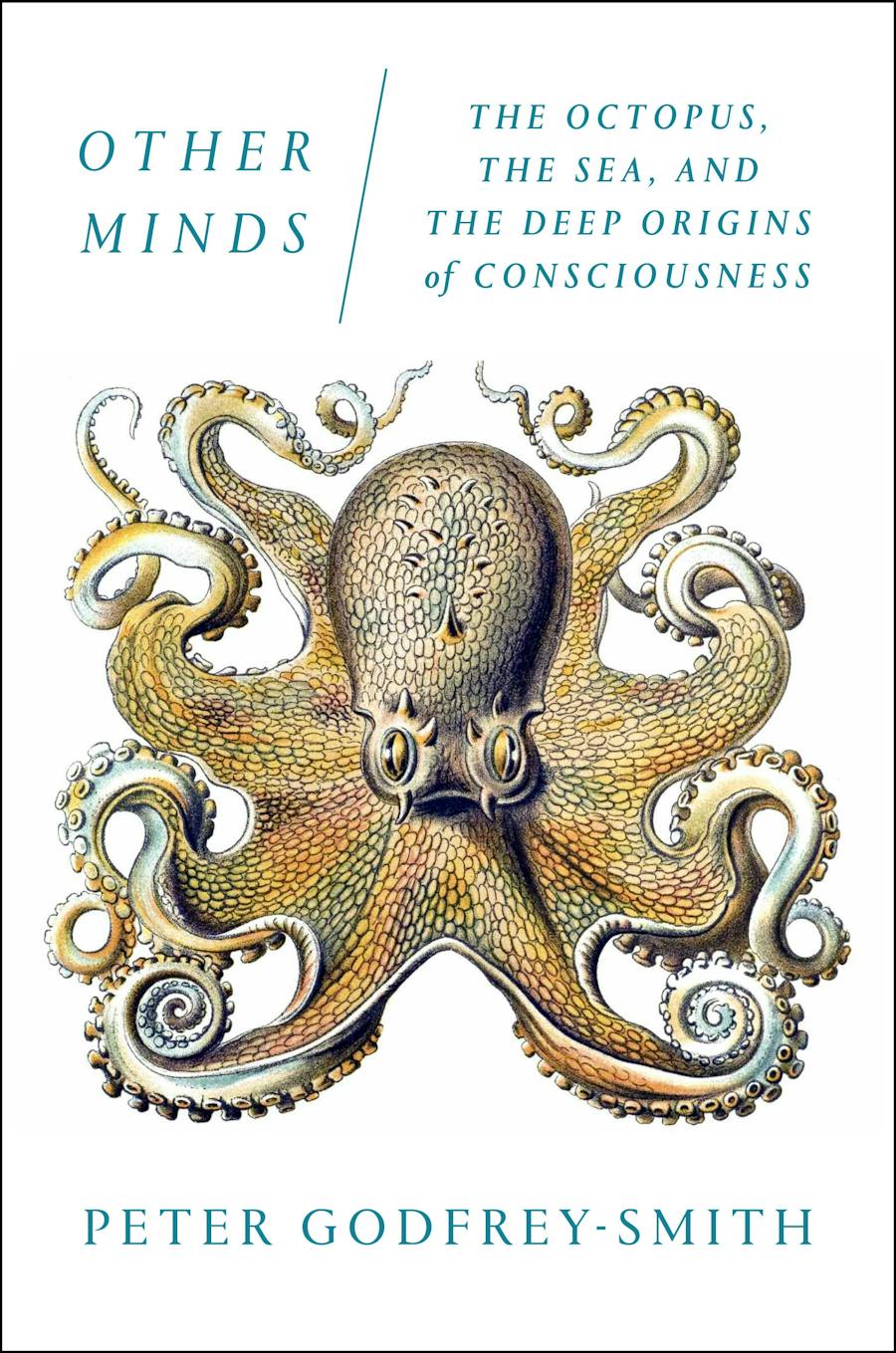
I recently finished Other Minds (2016), by philosopher and diver Peter Godfrey-Smith. It's a fascinating exploration of consciousness through the evolutionary history of cephalopods, particularly octopuses.
One of the ideas that stuck with me was how differently intelligence can be organized. Much of an octopus's nervous system resides in its arms, which can sense, explore, and respond to the world with considerable autonomy. It made me wonder not just how consciousness differs between organisms, but how it might differ between parts of the same organism. Does an octopus's arm have any conception of itself?
Another fascinating idea concerns how organisms distinguish changes in their environment from changes caused by their own actions. Our brains do this constantly, compensating for our movements so that the world appears stable. But versions of this capability exist in remarkably simple organisms. To me, the ability to distinguish something I did from something that happened to me suggests at least the beginnings of a sense of self. Perhaps something akin to consciousness exists much further down the evolutionary ladder than we generally imagine.
I'm continually struck by how extraordinarily complex and nuanced systems can emerge from relatively simple mechanisms, essentially on-off switches operating in concert.
I also found myself thinking about agentic AI. An octopus navigating the physical world through eight semi-autonomous arms seems an interesting analogy for a person navigating the digital world through software agents, working at the periphery of our attention and drawing us in when necessary.
Finally, Godfrey-Smith describes "Octopolis," a gathering of octopuses that appears to have originated around a discarded human object. Over time, the octopuses' activities transformed the surrounding habitat, attracting more life and enabling new behaviors. A wonderful example of unintended consequences and feedback loops, where organisms don't merely respond to their environments but continuously reshape them.
I finished the book thinking less about how uniquely sophisticated human consciousness is, and more about the remarkable things that can emerge from simple processes of sensing, acting, and responding.
A note from ChatGPT: Charlie brought the book, the observations, and the questions. My contribution was to help connect the ideas, challenge the distinction between self-awareness and subjective experience, and shape this reflection. There's something fitting about using a conversational AI to explore the possibility that intelligence is less centralized, and perhaps less exclusively human, than we tend to assume.
Read by someone who cares how the work actually moves. If your business has a process worth fixing, we should talk — work with us.